

Khunjerab National Park Fee Sparks Outcry: Tourists and Frequent Border Travelers Question High Charges and Lack of Transparency
HUNZA, GILGIT-BALTISTAN — The entry fee charged at Khunjerab National Park, particularly the significantly higher amount imposed on foreign visitors, is raising serious questions among tourists, frequent Pakistan-China border travelers and residents of Gilgit-Baltistan about affordability, transparency, accountability and the justification for repeatedly charging people who must travel through the park along the Karakoram Highway.
Khunjerab National Park is one of Pakistan’s most important protected areas and lies along the Karakoram Highway (KKH) leading from Sost toward the Pakistan-China border at Khunjerab Pass.
The park was established in 1975 and covers approximately 226,913 hectares, according to the Gilgit-Baltistan Forest, Wildlife & Environment Department. It was created primarily to protect the endangered Marco Polo sheep and is also important habitat for snow leopards and other high-altitude wildlife.
Conservation deserves public support.
But conservation fees must also be fair, transparent and accountable.
The growing question being asked by travelers and local stakeholders is simple:
How much is being collected at Khunjerab National Park, who receives this money, how is it spent, and why should travelers using an international highway be repeatedly charged without greater public transparency?
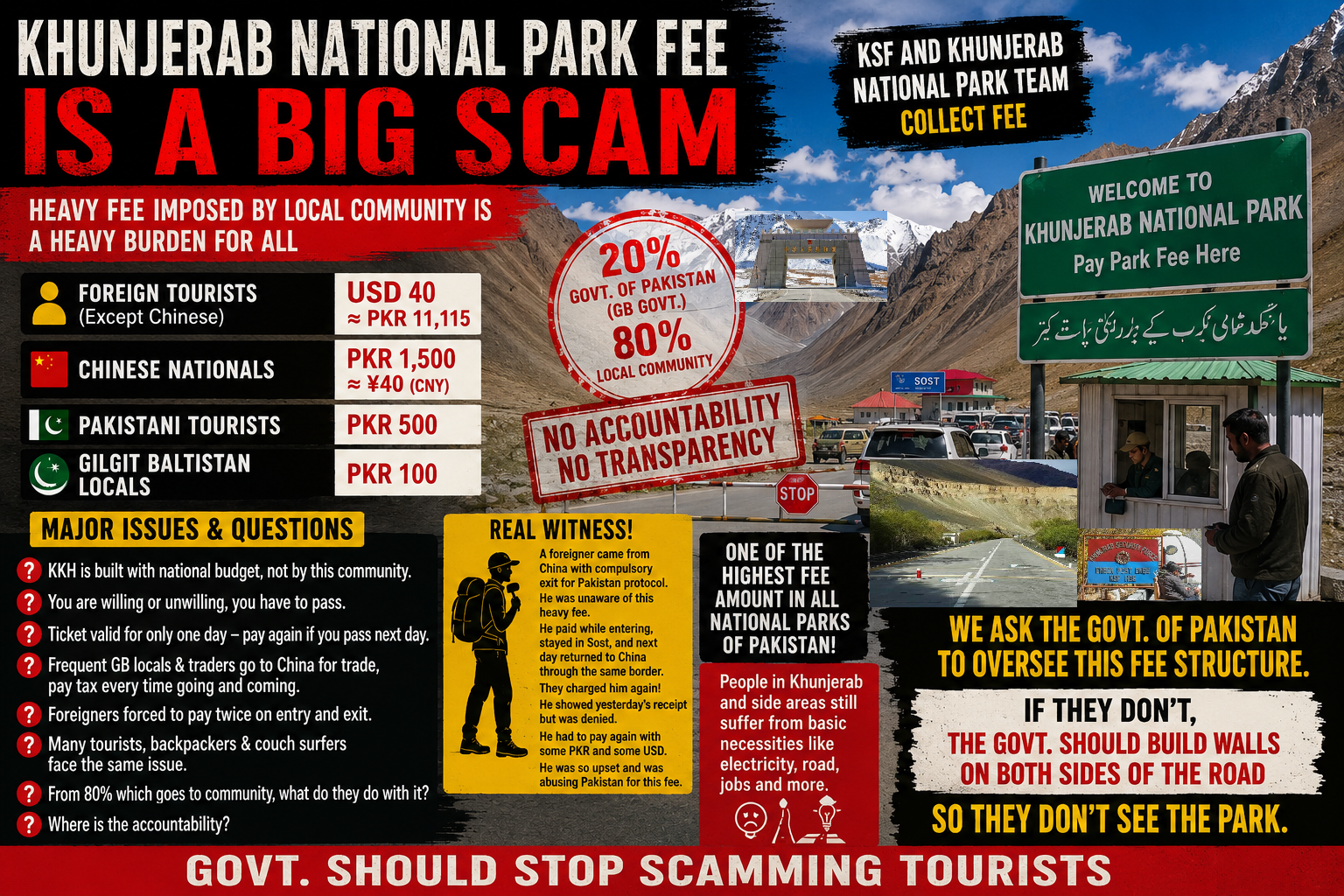
Foreign Tourists Reportedly Face a $40 Entry Fee
Published travel information and visitor reports have cited the Khunjerab National Park entry fee for most foreign tourists at around USD 40 per person, although rates reported online have varied over time.
At current exchange rates, USD 40 represents more than PKR 11,000, making a visit to Khunjerab considerably more expensive for an international backpacker or budget traveler than for a Pakistani tourist.
Separate rates have reportedly been applied to different categories of visitors, including Pakistani tourists, Chinese nationals and residents of Gilgit-Baltistan.
Commonly reported fee categories include approximately:
Foreign tourists other than specified categories: USD 40 per person
Chinese nationals: around PKR 1,500 or approximately RMB 40
Pakistani domestic tourists: around PKR 500 per person
Gilgit-Baltistan residents: around PKR 100 per person
However, Hunza Times stresses that fee schedules appear to have changed over time and different published sources continue to show conflicting amounts.
The relevant authorities should therefore publicly release an updated official fee notification, clearly stating every visitor category and applicable exemption.
Tourists should not have to depend on outdated blogs, Google results or word-of-mouth information to know how much they will be required to pay.
Why Such a Huge Difference Between Foreign and Domestic Visitors?
Charging different entrance fees to domestic and international tourists is not unusual in tourism.
Many countries operate differential pricing systems at national parks, museums and heritage attractions.
The question at Khunjerab, however, is whether the difference is proportionate and whether tourists receive sufficient information about where their money goes.
A Pakistani tourist reportedly paying around PKR 500 and a foreign traveler being asked to pay the equivalent of more than PKR 11,000 represents an enormous difference.
For wealthy organized tourists, USD 40 may be manageable.
For backpackers, cyclists, overland travelers, students and low-budget international visitors, however, it can become a significant unexpected expense.
This matters because Pakistan is actively trying to promote itself as an international adventure-tourism destination.
If foreign visitors encounter unexpectedly high mandatory charges without clear explanations, published fee structures or visible accountability, the experience can damage Pakistan’s tourism reputation.
The Karakoram Highway Passes Directly Through the National Park
One of the most controversial aspects of the Khunjerab National Park fee is geography.
The Karakoram Highway passes directly through Khunjerab National Park toward the Pakistan-China border.
This means that travelers heading legally between Pakistan and China through Khunjerab cannot simply choose another nearby public highway to avoid entering the park.
The KKH is a nationally significant international highway connecting Pakistan and China.
For an ordinary tourist deliberately visiting a national park, an entrance fee is understandable.
But what about a trader, cross-border passenger, driver, student, cyclist or international traveler who is primarily using the highway to travel between two countries?
Should every person passing through a protected area on an international transit route automatically be treated in exactly the same way as a recreational national park visitor?
This question deserves serious policy consideration.
Frequent Gilgit-Baltistan–China Travelers Face Repeated Costs
The issue is particularly relevant for people from Gilgit-Baltistan who frequently travel between Pakistan and China for trade, business and other legitimate purposes.
Sost has historically served as an important center for Pakistan-China trade.
For people who cross the border regularly, even relatively small fees can accumulate when charged repeatedly.
The government should therefore clarify whether different policies exist—or should exist—for:
Tourists visiting Khunjerab for recreation,
Local residents,
Commercial traders,
Drivers,
Cross-border workers,
Students,
Cyclists and overland travelers,
and passengers merely transiting through the protected area.
A national park conservation fee should not unnecessarily become a barrier to legitimate cross-border mobility.
Is the Ticket Valid for Only One Day?
Another major concern raised by travelers is the reported limited validity of the Khunjerab National Park ticket.
If a visitor pays the entry fee, travels through the park, stays overnight in Sost or crosses the border, and then returns through the same route the following day, should that traveler have to pay the full fee again?
This issue becomes especially serious for foreign travelers paying a much higher international visitor rate.
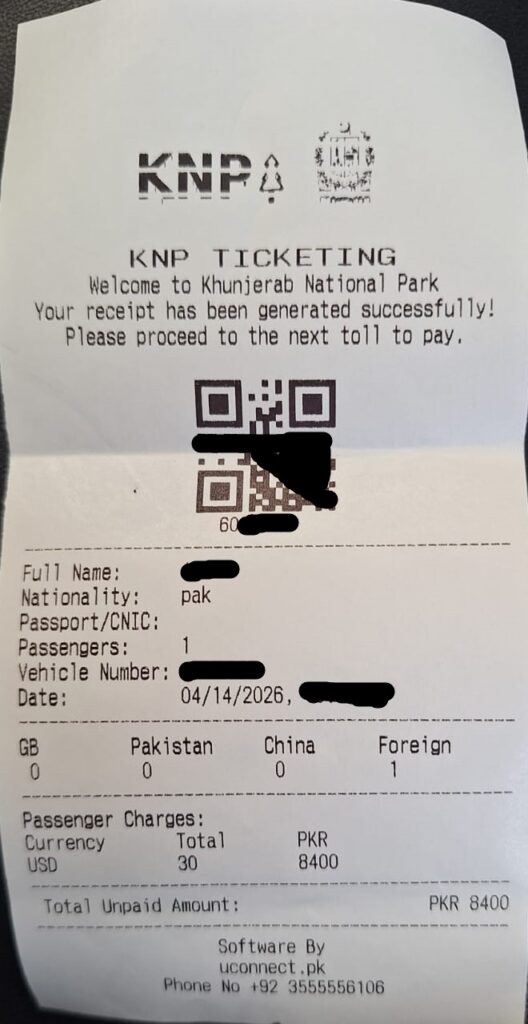
Hunza Times received an account concerning a foreign traveler who entered Pakistan from China through Khunjerab and reportedly paid the required park fee while entering.
According to the account, the traveler stayed overnight in Sost and returned toward China the following day.
When passing the park checkpoint again, he allegedly presented the receipt from the previous day but was told that a new payment was required because the earlier ticket was no longer valid.
The traveler reportedly did not have sufficient cash readily available and ultimately arranged payment using a combination of Pakistani currency and foreign currency.
Hunza Times has not independently verified the individual transaction or obtained the authorities’ version of the incident.
Nevertheless, the account raises an important policy question:
Should a traveler transiting the same route on consecutive days be required to pay the full national park fee twice?
If this is official policy, it should be clearly published before travelers enter the area.
Backpackers and Overland Travelers Can Be Hit Hardest
Pakistan has enormous potential as an overland tourism destination.
The Karakoram Highway attracts:
Backpackers,
Motorcyclists,
Cyclists,
Overlanders,
Adventure travelers,
Long-distance road trippers,
and independent international tourists.
Many of these travelers operate on modest daily budgets.
A sudden USD 40 charge can represent one or even several days of accommodation and food for a budget traveler.
Charging such visitors repeatedly because a ticket expires after one day could create an especially negative impression.
Tourism policy should consider not only how much money can be collected from a visitor today, but whether that visitor leaves Pakistan recommending the country to others.
One unhappy traveler can publish a review read by thousands of future tourists.
Where Does the Khunjerab National Park Fee Go?
Perhaps the biggest issue is not the existence of a fee.
It is transparency.
Local claims and community-related reports have suggested that a substantial proportion of Khunjerab National Park entry-fee revenue is allocated to local communities, with figures of around 80 percent for community-related distribution and 20 percent for government sometimes cited.
If this arrangement is accurate, authorities should publish the legal and administrative basis for it.
The public deserves answers to several straightforward questions.
How much money is collected annually from Khunjerab National Park entry fees?
What percentage goes to the Gilgit-Baltistan government?
What percentage goes to local community organizations?
Which organizations receive the money?
What is the role of KSF and other bodies involved in fee collection or revenue management?
Are annual audited financial statements publicly available?
How much is spent directly on wildlife conservation?
How much is spent on local development?
How much is spent on salaries and administration?
What measurable improvements have been achieved using this revenue?
These questions are not an attack on local communities.
They are basic questions of public accountability.
If millions of rupees are collected from tourists and travelers each year, transparent accounting benefits everyone—including the communities entitled to benefit from conservation.
Local Communities Should Benefit—but Benefits Must Be Visible
Communities living around protected areas often bear real costs.
They may face restrictions on grazing, hunting, land use and access to natural resources.
Wildlife can affect livestock and livelihoods.
Therefore, there is a strong and legitimate argument that communities living around Khunjerab National Park should receive meaningful economic benefits from conservation and tourism.
But community benefit-sharing should not mean an absence of accountability.
If a large share of park revenue is allocated to local communities, the public should be able to see how that money improves life in those communities.
Does it support:
Schools?
Healthcare?
Electricity?
Roads?
Clean drinking water?
Employment?
Waste management?
Wildlife conservation?
Scholarships?
Emergency services?
Tourism infrastructure?
Local residents in remote parts of Upper Hunza continue to raise concerns about basic services, employment opportunities, infrastructure and energy.
If substantial tourism revenue is being generated annually, residents have every right to ask whether that revenue is producing measurable local development.
Revenue Must Not Benefit Only a Small Group
Community-based conservation works best when benefits are distributed fairly.
It fails when ordinary residents cannot see where the money goes.
Any revenue-sharing system associated with Khunjerab National Park should therefore include transparent rules preventing funds from disproportionately benefiting a small number of individuals or influential families.
There should be publicly accessible information showing:
Annual revenue,
Annual expenditure,
Community development projects,
Conservation spending,
Administrative costs,
Beneficiary-selection criteria,
and independent audit results.
Without such information, suspicion and allegations will continue.
Transparency protects honest community institutions just as much as it protects tourists and taxpayers.
The Government Must Clarify KSF’s Role
Travelers frequently associate fee collection and park management with the Khunjerab National Park administration and community-linked structures, including references to KSF.
The relevant authorities should publicly explain exactly which organization is legally authorized to:
Set entrance fees,
Collect payments,
Issue tickets,
Manage revenue,
Distribute community shares,
Conduct audits,
and decide how the money is spent.
There should be no confusion at an international tourist destination of this importance.
Every ticket should clearly state:
The official fee,
Visitor category,
Date and validity,
Issuing authority,
Tax or government component,
and ideally a QR code or digital verification mechanism.
Cash-only systems with limited publicly available information naturally create concerns about transparency.
Digital ticketing could significantly improve accountability.
Introduce Digital Tickets and Public Revenue Reporting
The Gilgit-Baltistan government should modernize the Khunjerab National Park fee system.
A transparent digital system could allow visitors to:
Check official fees online,
Pay electronically,
Receive digital receipts,
Verify ticket validity,
Understand re-entry rules,
and see exactly which authority collected the payment.
At the end of every tourism season, the government and relevant community organizations should publish a simple public report:
Total visitors
Total revenue collected
Government share
Community share
Conservation expenditure
Development expenditure
Administrative costs
Projects completed
This would immediately reduce suspicion and improve public confidence.
Should Transit Passengers Pay the Same as Tourists?
Pakistan should also reconsider whether all users of the Karakoram Highway should be charged under the same model.
A person traveling specifically to Khunjerab National Park for sightseeing is different from someone crossing the park because the international highway happens to run through it.
Possible categories could include:
National park tourist ticket
for recreational visitors;
Transit pass
for Pakistan-China border passengers;
Annual local pass
for frequent Gilgit-Baltistan travelers;
Trader pass
for registered cross-border business travelers;
and
Multi-day ticket
for tourists staying in the region for several days.
Such a system could protect conservation revenue without repeatedly penalizing legitimate road users.
Why Should a One-Day Ticket Require Full Payment Again?
If the current ticket is valid for only one day, authorities should reconsider this rule.
A more tourist-friendly system could provide:
A 24-hour or 48-hour transit ticket,
A three-day visitor pass,
A seven-day park pass,
or a same-route return exemption.
For example, a foreign overland traveler entering Pakistan through Khunjerab, sleeping in Sost and returning to China the next day should not face confusion about whether another USD 40 payment is required.
The rule should be explicit before payment.
Tourists should never discover such conditions only when they reach the checkpoint.
Conservation Cannot Become an Excuse for Unreasonable Charges
Khunjerab National Park must be protected.
Its Marco Polo sheep, snow leopards, Himalayan ibex, fragile alpine ecosystems and extraordinary landscapes are national treasures.
But conservation requires public trust.
High entrance fees can be justified only when visitors and communities can clearly see that the money supports:
Wildlife protection,
Habitat conservation,
Park management,
Waste control,
Tourist safety,
Scientific research,
and sustainable community development.
Simply collecting money under the name of conservation is not enough.
The public has the right to know what happens after the ticket is sold.
Khunjerab Is Not an Ordinary Gated Tourist Attraction
Khunjerab National Park is unusual because a major international highway passes through it.
The Karakoram Highway was constructed as a strategic national and international infrastructure project connecting Pakistan and China.
Travelers heading toward the border cannot simply bypass the protected area on another road.
This makes Khunjerab fundamentally different from a national park where tourists voluntarily turn off a public highway and enter a separate recreational zone.
That unique geography requires a smarter fee policy.
The government must balance three interests:
Conservation
Community rights
and
Freedom of legitimate transit
None should automatically cancel out the others.
Government of Gilgit-Baltistan Must Review the Fee Structure
Hunza Times calls on the Government of Gilgit-Baltistan and relevant wildlife, tourism and finance authorities to conduct a transparent review of the Khunjerab National Park fee system.
The review should examine:
- Whether the USD 40 foreign tourist fee is proportionate and competitive.
- Whether transit passengers should pay the same rate as recreational tourists.
- Whether one-day ticket validity is reasonable.
- Whether frequent local traders and travelers should receive annual or multi-entry passes.
- Whether same-route return travelers should be charged twice.
- Whether the reported community/government revenue-sharing arrangement is legally documented and publicly audited.
- How much revenue has been collected annually over the past five to ten years.
- Exactly how community revenue has been spent.
- Whether conservation outcomes have improved in proportion to revenue.
- Whether digital ticketing and public financial reporting should become mandatory.
Publish the Accounts
If the system is fair, there should be nothing to hide.
Publish the numbers.
Publish the fee notification.
Publish annual visitor numbers.
Publish how much money was collected.
Publish the government share.
Publish the community share.
Publish the projects funded.
Publish the conservation expenditure.
Publish independent audits.
Doing so would protect the reputation of the government, park administration and local community organizations.
Without transparency, even a legitimate conservation fee risks being viewed by travelers as an arbitrary toll.
Tourism Should Leave Visitors With Good Memories—not Anger at a Checkpoint
Gilgit-Baltistan is one of Pakistan’s greatest tourism assets.
Hunza has built an international reputation for hospitality, safety, mountain landscapes and cultural diversity.
A tourist who travels thousands of kilometers to Pakistan should leave talking about:
Rakaposhi,
Attabad Lake,
Passu Cones,
the Karakoram Highway,
the hospitality of Hunza,
and the beauty of Khunjerab.
They should not leave Pakistan primarily remembering an argument over an unexpected fee at a checkpoint.
Every interaction with a foreign visitor shapes Pakistan’s international tourism image.
A poorly explained charge can undo millions of rupees spent on tourism promotion.
Khunjerab Belongs to Future Generations Too
The debate over Khunjerab National Park fees should not become a conflict between tourists, government and local communities.
All three have legitimate interests.
Wildlife needs protection.
Local communities deserve economic benefits.
Government has responsibilities for conservation and administration.
Tourists should contribute reasonably toward protecting the places they visit.
But the system must be fair, transparent, accountable and proportionate.
Khunjerab is one of the most extraordinary landscapes in Pakistan.
Its conservation should never become synonymous with unexplained charges.
If substantial revenue is collected in the name of Khunjerab National Park, the people of Gilgit-Baltistan and the tourists who pay those fees deserve to know where every rupee goes.
The Government of Gilgit-Baltistan should urgently review the fee structure, publish the official revenue-sharing mechanism, introduce transparent digital ticketing, provide multi-day and transit options, and release audited accounts showing how park revenue benefits conservation and local communities.
Until those questions are answered, controversy over the Khunjerab National Park fee will continue.
Editor’s Note
This article raises public-interest questions regarding the Khunjerab National Park entry-fee system. Some fee figures and revenue-sharing claims circulating among travelers and local stakeholders require updated official confirmation. Hunza Times invites the Gilgit-Baltistan Forest, Wildlife & Environment Department, Khunjerab National Park administration, KSF or relevant community organizations, and the Government of Gilgit-Baltistan to provide official fee notifications, revenue-sharing documents, audited accounts and a response for publication.